Services Process Case Studies
Why SoftEdge
Free Tools
Get in Touch →
Introducing PrivacyEdge

DPDP Compliance Made Simple

PrivacyEdge is an all-in-one compliance engine built specifically to help Indian companies automate data privacy safeguards, secure consent logs, and shield their operations from the severe penalties of the DPDP Act.

Request Live Demo → Explore Features
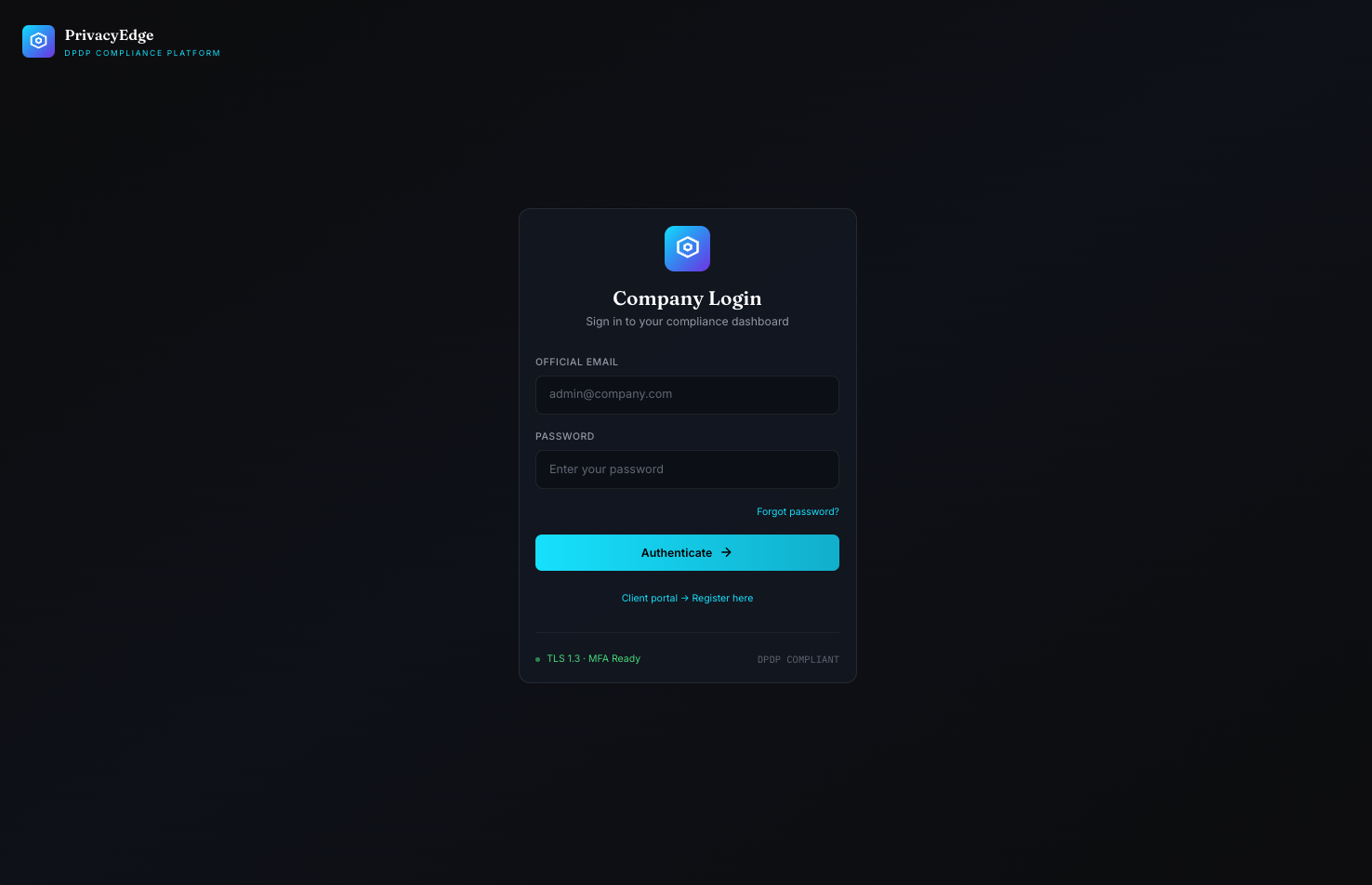
PrivacyEdge DPDP Compliance Application interface showing consent manager, audit trails, and data subject rights dashboard

Automate Compliance Workflows

🗂️

Centralized Consent Ledger

Track, log, and store explicit user consents programmatically. Generate itemized and downloadable consent notice templates that satisfy DPDP Section 6 criteria, with full support for multilingual notices.

👤

Data Principal Rights Portal

Provide a self-service compliance dashboard for your customers. Enable them to request data access, seek corrections, withdraw consent, or demand data erasure (DPDP Section 11 & 12) automatically.

🛡️

Data Fiduciary Audit Trails

Maintain an immutable, timestamped ledger of all personal data activities. Instantly generate audit-ready compliance logs for internal audits or when responding to inquiries from the Data Protection Board of India (DPBI).

🚨

Breach Alert Notification

DPDP rules mandate immediate reporting of data breaches. PrivacyEdge monitors integration endpoints and automatically triggers compliance alerts to notify both the Board and affected users in real time.

How PrivacyEdge Solves the DPDP Act

DPDP Act Section 5 & 6

Consent & Notice Architecture

Under the DPDP Act, personal data can only be processed on the basis of **unambiguous, specific, unconditional, and informed consent**. Consent requests must be accompanied or preceded by a detailed notice explaining the purposes of processing and what data points are collected.

PrivacyEdge Technical Resolution:

  • Multilingual Notices: Pre-built consent modules localized in English and all 22 scheduled regional languages.
  • Granular Settings: Allow users to toggle consent for separate processing tasks rather than a single 'all-or-nothing' click.
  • Consent Ledger: Secure log mapping User ID, timestamp, notice version, and IP to provide irrefutable audit evidence.
DPDP Act Section 11 & 12

Data Principal Rights

Individuals (Data Principals) are granted extensive rights over their data. These include the right to access summaries of their data, request corrections, complete incomplete records, withdraw consent, and request complete erasure.

PrivacyEdge Technical Resolution:

  • Self-Service Portal: Ready-to-embed consumer portal where users can request data summaries and manage preferences.
  • Consent Withdrawal Handling: Automated API hooks that trigger database scripts to stop data processing instantly upon withdrawal.
  • Erasure Workflows: Orchestrates verification and secure deletion pipelines across your cloud and databases.
DPDP Act Section 8

Significant Data Fiduciary Duties

Entities categorized as Significant Data Fiduciaries (SDF) due to volume, sensitivity, or risk to public order face enhanced duties. They must appoint a resident Data Protection Officer (DPO), hire an independent auditor, and carry out periodic Data Protection Impact Assessments (DPIAs).

PrivacyEdge Technical Resolution:

  • Auditor Access Controls: Read-only, secure compliance auditor dashboard to speed up independent audit reporting.
  • DPIA Templates: Centralized compliance dashboard containing risk mapping and assessment logs.
  • DPO Dashboard: Dedicated console for your DPO to manage data requests, grievances, and alerts.
DPDP Act Section 8(6)

Breach Notification & Safeguards

Data Fiduciaries must implement reasonable security safeguards to prevent personal data breaches. In the event of a breach, companies are legally mandated to notify the Data Protection Board of India (DPBI) and each affected individual immediately.

PrivacyEdge Technical Resolution:

  • Breach Detection Monitors: Real-time API monitoring to detect unauthorized exports, access anomalies, or system leaks.
  • One-Click Notifications: Automatic draft generator for incident reports to the DPBI containing required timelines and metrics.
  • Bulk User Alerting: Integrated mail/SMS gateway to notify affected users within statutory windows.
Why PrivacyEdge

The DPDP Compliance Checklist

Mitigate risk and transition from manual processes to automated compliance guardrails.

Itemized & Bilingual Notices

Provide consent requests in English and any scheduled Indian language relevant to the user, with specific, itemized descriptions of what personal data is being processed.

Easy Consent Withdrawal

Allow users to withdraw consent as easily as it was given. PrivacyEdge automatically updates backend data pipelines to stop processing upon withdrawal.

Nominee Mapping & Minor Protection

Support setting up nominees for individuals in case of death or incapacity, and verify parental consent flows for processing child data securely.

Massive Penalty Mitigation

Prevent statutory financial penalties of up to ₹250 Crores by maintaining compliant records, secure processing protocols, and an audit-trail proof system.

DPDP Compliance Frequently Asked Questions

Basics & Definitions
India's comprehensive data protection law governing the processing of digital personal data. Passed by Parliament on August 11, 2023, it establishes rights for individuals (Data Principals), obligations for organisations (Data Fiduciaries), and sets up the Data Protection Board of India for enforcement.
Officially notified on January 3, 2025. The Rules provide detailed implementation guidelines covering notices, consent managers, security safeguards, breach notification, and cross-border transfers.
Any data about an individual who is identifiable by or in relation to such data. Covers name, Aadhaar, PAN, email, phone, biometrics, financial data, health records, IP addresses, device IDs, etc. Unlike GDPR, the DPDP Act does not have a separate 'sensitive personal data' category — all personal data is treated similarly.
Any person/organisation that alone or jointly determines the purpose and means of processing personal data. If your organisation decides why and how data is used, you are a Data Fiduciary.
The individual to whom the personal data relates. For children (under 18) or persons with disabilities, the parent or lawful guardian acts as the Data Principal.
Any entity that processes personal data on behalf of a Data Fiduciary. Processors follow the fiduciary's instructions and have contractual (not direct DPDPA) liability.
An extremely broad definition covering collection, recording, storage, retrieval, use, sharing, disclosure, restriction, and erasure. Even viewing personal data on a screen counts as processing.
No. The Act applies only to personal data in digital form. Non-digital and non-personal data remain unregulated under the DPDP Act.
No. Personal data processed by individuals for personal or domestic purposes is exempt. So are data made publicly available by the Data Principal themselves.
No. There is no exemption or grace period based on company size, headcount, or revenue. If you process digital personal data, the Act applies from day one.
Consent & Notice Requirements
Consent must be free, specific, informed, unconditional, and unambiguous — given through clear affirmative action. Pre-ticked checkboxes, buried consent in T&Cs, or bundling with unrelated services are invalid.
The personal data being collected, purpose of processing, how to exercise rights, and how to complain to the Data Protection Board. The notice must be available in English AND any of the 22 Scheduled Indian languages chosen by the Data Principal.
Yes — at any time, and withdrawal must be as easy as giving consent. Once withdrawn, processing must stop and data must be erased unless legally required to be retained.
Voluntary provision of data for a specified purpose, state functions (subsidies, benefits, certificates), legal obligations, medical emergencies, employment-related processing, and public interest (mergers, acquisitions).
A registered entity that enables Data Principals to give, manage, modify, or withdraw consent across multiple Data Fiduciaries through a single platform — similar to Account Aggregators in financial services. Unique to India's framework.
This is a debated area. Critics argue the Act allows companies to assume consent in several situations, which could be misused. The 'voluntary provision' legitimate use is particularly contentious.
Data Principal Rights & Duties
Right to access information, right to correction/erasure, right to grievance redressal, and right to nominate someone to act on their behalf.
No. Unlike GDPR, the DPDP Act does not include a right to data portability. This has been criticised by privacy advocates for locking users into platforms.
Within 7 days of receiving a valid request. The response must include a summary of data processed, processing purposes, and categories shared with third parties.
They must provide authentic information, not file false or frivolous complaints, not impersonate others, and not suppress material information. Penalty: up to ₹10,000 for false complaints.
Data Fiduciary Obligations
Lawful, transparent, and secure processing; limiting collection to necessary purposes; providing clear privacy notices; implementing reasonable security safeguards; enabling grievance redressal; and responding to data breaches.
A Data Fiduciary notified by the Central Government based on the volume and sensitivity of data processed, risk of harm, impact on sovereignty/public order, and use of new technologies.
Appoint a Data Protection Officer (DPO) based in India, appoint an Independent Data Auditor, conduct Data Protection Impact Assessments (DPIAs), undergo periodic audits, and maintain records for 7 years.
A mandatory assessment by SDFs before high-risk processing. It evaluates the nature, scope, risks to Data Principals, mitigation measures, and proportionality.
Children's Data
Any individual who has not completed 18 years of age. This is more conservative than GDPR (which allows 13-16 depending on member states).
Verifiable parental consent is mandatory before processing. Behavioral monitoring, targeted advertising, and any processing likely to harm a child's well-being are explicitly prohibited.
Yes — healthcare services, educational institutions, child safety/protection services, and other classes notified by the Government are exempt from the verifiable consent requirement.
Data Breach & Security
Notify both the Data Protection Board of India AND affected Data Principals within 72 hours of becoming aware of a breach. The notification must describe the nature, data affected, consequences, and remediation measures.
Reasonable security safeguards including encryption (at rest and in transit), access controls, authentication, regular security testing, incident detection, security policies, employee training, vendor management, and incident response plans.
Up to ₹200 crore.
Cross-Border Data Transfers
Yes — the default position is permissive: transfers to all countries are allowed. However, the Government can notify a 'negative list' of restricted countries where transfers are prohibited.
No blanket data localization is mandated. However, sectoral regulations (RBI, SEBI, IRDAI) may require localization for specific data types, and the government can notify restricted jurisdictions.
Yes. The Act has extra-territorial application. Any foreign entity processing personal data of individuals in India in connection with offering goods or services is bound by the DPDP Act, regardless of where the servers or company are located.
Yes. The DPDP Act binds any foreign company processing personal data of individuals located in India, even if the processing occurs entirely outside India.
Data Protection Board & Enforcement
The regulatory body established under the Act that functions as a 'digital office.' It inquires into non-compliance, imposes penalties, issues directions, and registers Consent Managers.
Appeals go to the Telecom Disputes Settlement and Appellate Tribunal (TDSAT) within 60 days (extendable by 60 days). Further appeal to the Supreme Court on questions of law only.
The Act received Presidential assent on August 11, 2023, and the DPDP Rules were notified on January 3, 2025. Businesses are expected to comply as enforcement provisions come into effect. No universal enforcement date has been announced — the government can notify different provisions on different dates.
Penalties
Penalties are structural and depend on the breach: up to ₹250 Crores for failing to take security safeguards to prevent breaches; up to ₹200 Crores for failing to notify a breach; up to ₹150 Crores for non-compliance with children's data guidelines; and up to ₹50 Crores for general non-compliance. False complaints by Data Principals can attract a fine of up to ₹10,000.
No. The 2023 Act removed criminal penalties that were in earlier drafts. Enforcement is through civil monetary penalties and Board directions only.
Nature, gravity, and duration of the breach; type of personal data affected; number of Data Principals affected; whether the breach was intentional or negligent; mitigation steps taken; and the entity's compliance history.
Exemptions
Processing related to national security, public order, prevention of offenses, legal proceedings, research/archiving/statistical purposes (with safeguards), and notified startups may get relaxations.
Yes, but with broader exemptions. Government processing for subsidies, benefits, services, certificates, and licenses is a legitimate use. Additionally, exemptions exist for national security and public order purposes.
Business & Compliance
Include: clear data collection statements and purposes, Data Principal rights, consent withdrawal mechanism, grievance redressal process, DPO contact (for SDFs), data retention periods, cross-border transfer info, and complaint mechanism to the Data Protection Board.
Consent records, data inventory, Data Principal request logs, breach incident records, vendor/data processing agreements, employee training records, DPIA reports (SDFs), and audit reports. SDFs must retain records for 7 years.
Employee data processing is a Legitimate Use for recruitment, onboarding, attendance, performance, salary, and termination. Best practice: update employment contracts, provide privacy notices, train HR staff, secure personnel files, and define retention periods.
DPDPA supplements the IT Act. Section 43A (compensation) is amended; Section 72A (breach of confidentiality) continues; the SPDI Rules 2011 are effectively superseded; and Section 69A (blocking) continues independently.
Yes — Section 11 provides a right to erasure, but it is narrower than GDPR's right to be forgotten. The Data Fiduciary must erase data upon request unless retention is required by law.
DPDPA vs GDPR
Core concepts (consent, accountability, individual rights) are similar, but DPDPA is a more principles-based, India-specific model. Key differences: no data portability right, no separate sensitive data category, a permissive cross-border transfer approach (blacklist vs GDPR's whitelist), penalty-only enforcement (no criminal liability), and broader government exemptions.
No. While there is overlap, the DPDP Act has distinct requirements — different notice language rules, consent manager provisions, children's data age threshold, employee data treatment, and government exemptions. A separate compliance gap analysis is essential.
Startups & SMEs
Yes. There is no revenue, headcount, or stage-based exemption. If you process digital personal data, the Act applies. Startups should begin with a simple data-mapping exercise: what data is collected, why, where it's stored, and who has access.
Prepare a data inventory cataloging data flows; update your privacy policy with DPDPA-compliant notices; establish an easy consent interface; and create a responsive grievance redressal channel (like a dedicated compliance email).
Ed-tech (children's data + verifiable parental consent), health-tech (sensitive health data), fintech (sectoral overlap with RBI), e-commerce (consent at scale), and SaaS (acting as data processors for multiple fiduciaries).
Public Concerns & Criticisms
Criticisms include the lack of data portability right (locking users into platforms), broad government exemptions for national security/public order, potential issues with 'deemed consent' or voluntary provision clauses, and concerns regarding the autonomy and independence of the Data Protection Board of India.
This remains an unresolved grey area. Political parties are not explicitly exempted, but the broad government and public-interest exemptions may apply. The Data Protection Board has yet to rule on this.
First approach the Data Fiduciary's grievance redressal mechanism. If unresolved or unsatisfactory, escalate to the Data Protection Board of India through its digital office.

Ready to Secure Your Compliance?

Get a live, tailored walkthrough of the PrivacyEdge dashboard. See how easy it is to integrate consent mapping, data logs, and data principal request portals directly into your app.

Request Demo Walkthrough →